












Biothalassol: What You Need to Know About Sea Plasma
Salt Marshes: Where French Sea Salt Comes From
Biothalassol has successfully anchored in our e-shop. Of course, we tried the products ourselves before including them, because we want to be sure we offer guaranteed quality. And actually, if you know how French legislation works, you can't go wrong when selecting other products with organic certifications. The French simply know their stuff and want to offer the best on the market. Let's take a look together at the Atlantic surroundings and Eaux-méres (salt marshes).
Eaux-méres is a term you will encounter quite frequently with Biothalassol. It is not “ordinary” seawater, but water from salt marshes (salted swamps). These are not swamps in the true sense, as we know them from fairy tales. Salt marshes are reservoirs separated from Atlantic waters and serve primarily to retain water for the French salt industry. Ocean water is transported into various consecutive basins and crystallizers.
Slow water circulation, controlled by the salt producer, supports evaporation and thus the concentration of salty water. This method typically produces coarse salt and fleur de sel (salt flower). During its journey from the sea to the salt marsh, the salt concentration in the water increases tenfold. It ranges from 30 grams of salt per litre up to 300 grams of salt per litre in the reservoirs where coarse salt and fleur de sel are harvested. The most famous French salt production area is Guérande, a region recorded under UNESCO and named Natura 2000. This is where Biothalassol's sea plasmas come from.
The three parts of a salt marsh are:
- A reservoir with seawater
- Evaporation basins
- Crystallizers
Water from salt marshes is much richer in magnesium concentration than pure seawater
The salt marshes on the Guérande peninsula (a protected area classified as Natura 2000) are symbolic places for traditional salt harvesting in western France. The seawater from the last evaporation parts of the saltworks, reservoirs where salt workers collect salt throughout the summer season, is water with the highest natural concentration of minerals and trace elements, including magnesium, calcium, phosphorus, sodium, and potassium. Mother waters from this part of the salt marshes stand out for their high concentration of magnesium chloride.
When it is suitable to reach for sea plasma
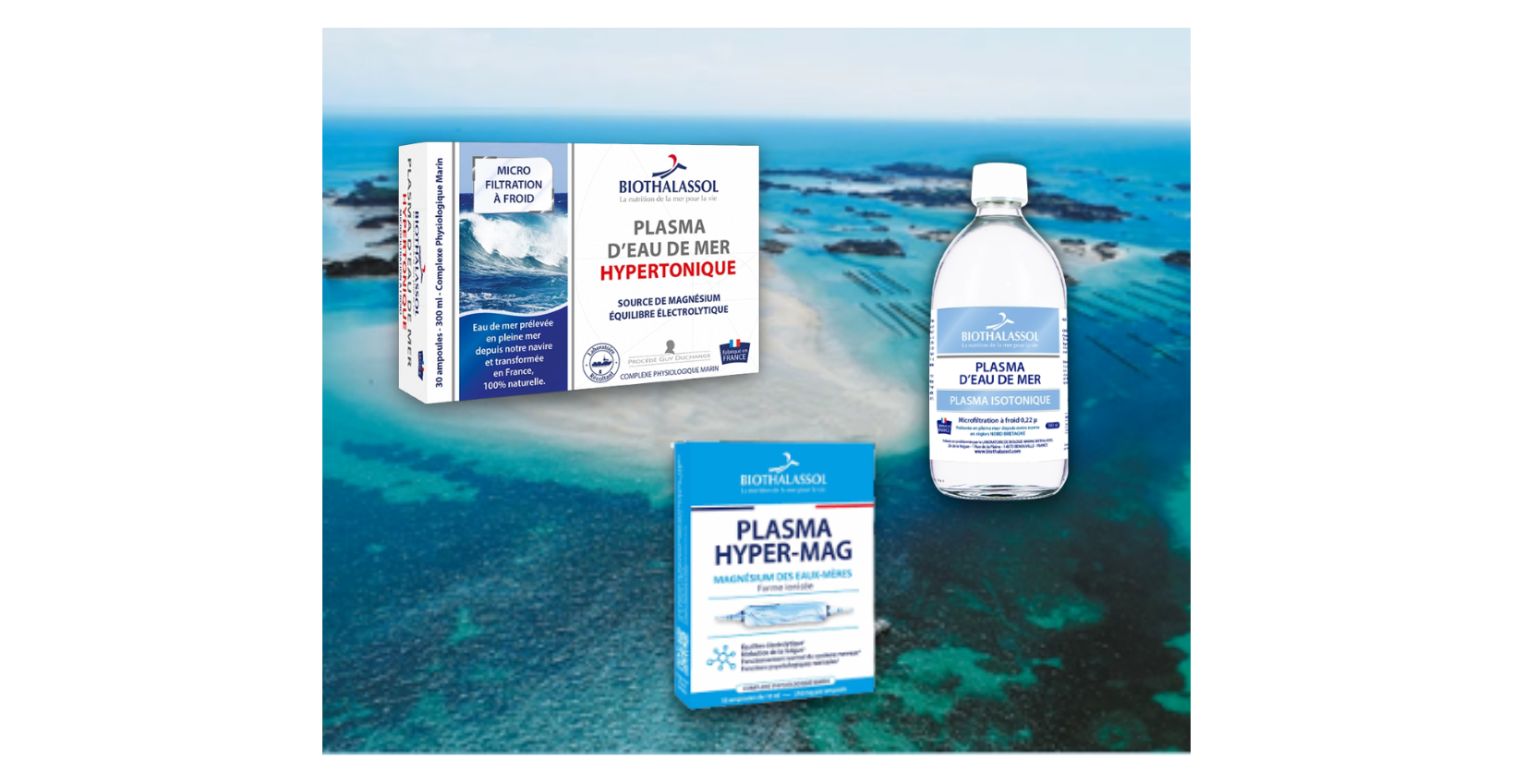
Sea plasma excels in richness of minerals and trace elements, specifically sodium, magnesium, sulfur, potassium, and calcium, but also iodine, fluorine, and phosphorus. It is sold in two forms: isotonic (composition closest to human plasma) and hypertonic (more concentrated). Isotonic sea plasma is obtained by diluting one part of hypertonic sea plasma in three parts of low-mineral spring water.
When it is good to include it as a dietary supplement:
- In case of convalescence
- Between seasonal changes
- During increased physical activity
- During menstruation or menopause
- In summer, when you lose minerals through increased sweating
- If you feel physically and mentally exhausted
Choose isotonic or hypertonic plasma?
The seawater from Biothalassol is collected in places known under the protective name Natura 2000. To ensure optimal quality and genuine purity, the plasma undergoes double filtration at 0.2 microns cold, without high-temperature treatment or irradiation. Many people ask which plasma form to choose, isotonic or hypertonic.
Hypertonic sea plasma:
- Hypertonic sea plasma is seawater in its complete form. Its saltiness is approximately 33 grams of salt per litre, and the concentration of minerals and trace elements is relatively high.
- It allows rapid remineralization of an organism exhausted by physical or intellectual exertion and is used as a cure for a maximum of 3 weeks. This plasma is also ideal for preparation for a detoxification cure.
- It is also suitable for remineralization during renewal of food intake after fasting. During fasting, it is useful for addressing low blood pressure, muscle pain, or feeling faint.
- However, it is contraindicated in hypertension, kidney failure, heart problems, salt-free diets, during pregnancy, and in seniors. Usage is not recommended at evening time.
- You can take it for one week per month to boost energy if you are an active sportsman. In this case, the recommended dose is 10 to 30 ml daily, in the morning or at noon.
- The hypertonic solution is more concentrated in mineral salts. Its pure use is indicated in specific cases. For example, for athletes after intense physical effort, but also during phases of strong fatigue. It helps quickly restore energy and balance of your body.
Isotonic sea plasma:
- Isotonic sea plasma is the diluted version of hypertonic. It contains 9 grams of sodium per litre, like human tears, and is also compositionally very similar to our blood plasma in terms of mineral and trace element concentration. It is used long-term, typically in chronic issues (mineral deficiencies, e.g., in tetany), skin problems, fatigue, mental exhaustion (convalescence after burnout) until complete restoration of overall vitality. For immunity support, it is recommended to perform two three-week cures annually, in periods of fatigue or at the beginning and end of winter.
How is sea plasma useful for athletes?
Some scientific studies focusing on the possible benefits of sea plasma use for both professional and hobby athletes yielded fairly good results, showing that seawater demonstrated benefit in rehydration of athletes after physical exertion causing significant water loss in the body. However, these studies are too limited to draw practical conclusions. The authors themselves state that further research is needed to examine the benefits of sea plasma in professional and hobby sports in more detail and over a longer term. Overall hydration of the organism, not only in athletes, depends not only on sea plasma intake but also on a well-balanced overall drinking regime.
Sea plasma: What are the side effects? What are the contraindications?
It is fair not only to highlight the advantages of sea plasma but also to repeat once again that it is not suitable for everyone. Specific groups should not use it or need to consult their treating doctor about its inclusion as a dietary supplement. These specific cases are:
- If you are on a salt-free diet.
- If you are pregnant (consultation for isotonic variant use is recommended).
- If you suffer from kidney failure.
- If you have high blood pressure or cardiovascular disease. Sea plasma is rich in sodium and is contraindicated in this case.
- If you have water retention problems.
- If you have undergone transplantation.
- The iodine content can be problematic in thyroid diseases, whether hyperthyroidism or hypothyroidism, or iodine allergy.
- Hypertonic plasma and increased magnesium concentration can cause issues in people with sensitive intestines.
- Isotonic plasma use for children from five years old can be considered after consultation with the treating doctor; the same rules apply for seniors.
- The method of use is stated on all products in our e-shop.
Fluid type influences acute hydration and muscle performance recovery in human subjects, Journal of the International Society of Sports Nutrition, 2019.
Potential health benefits of deep sea water: a review, Hindawi, 2016.
Deep mineral water accelerates recovery after dehydrating aerobic exercise: a randomised, double-blind, placebo-controlled crossover study, Journal of the International Society of Sports Nutrition, 2014.
https://www.youtube.com/watch?v=mSsCLvJgVWE&ab_channel=Lesproducteursdeselsdel%27Atlantique
https://www.selsdelatlantique.fr/comment-fonctionne-un-marais-salant/
https://aopk.gov.cz/natura-2000